Block Dominoes, with no boneyard rescue
No boneyard rescue - Pass when stuck and win the count when the line locks.How to Play Block Dominoes
In a nutshell: No boneyard rescue - Pass when stuck and win the count when the line locks. You play with a double-six set (28 tiles), it's rated simple & pure, and about 50/50 - pip counting decides the blocked games.
Block Dominoes strips the game to its purest form: seven tiles each, one line, and no boneyard rescue. If you cannot match either open end you simply pass, so every tile in your starting hand has to earn its place. The fourteen tiles left out of the deal stay face down and unseen, which makes deduction - Working out what your opponent can and cannot hold - The beating heart of the game. Hands end two ways: someone plays their last tile, or the line locks with both players stuck, and then the lower pip count wins. That second route is where Block is won and lost; strong players steer toward a block when their hand is light and force the game open when it is heavy. It is the standard game across the Caribbean and Latin America for good reason.
Block at a glance
| Goal | Play all seven of your tiles first, or hold the lighter hand when the line locks - There is no boneyard to save you. |
|---|---|
| Set used | Double-six - 28 tiles in play |
| Players | 2 - You vs the computer, or a friend online |
| Difficulty | Simple & pure |
| Chance of winning | About 50/50 - Pip counting decides the blocked games |
| Family | Classic |
Step by step
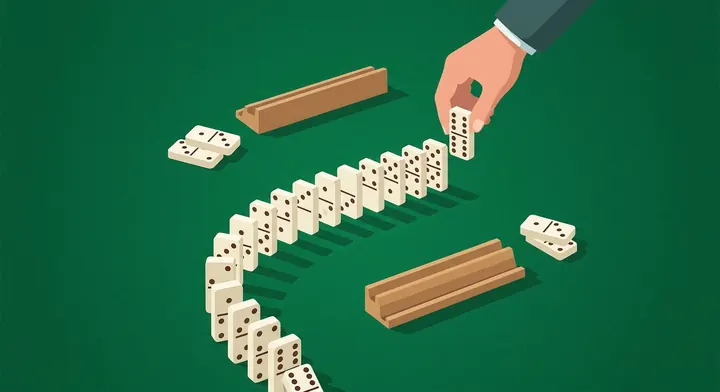
Goal
Play all seven of your tiles first, or hold the lighter hand when the line locks - There is no boneyard to save you.
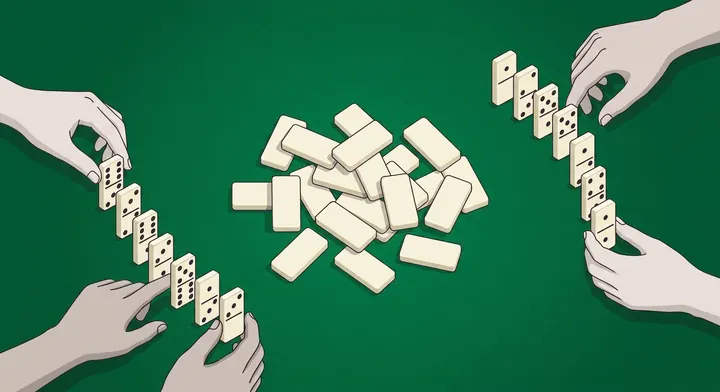
The deal
Each player draws seven tiles from the double-six set; the other fourteen are set aside face down and never enter play.
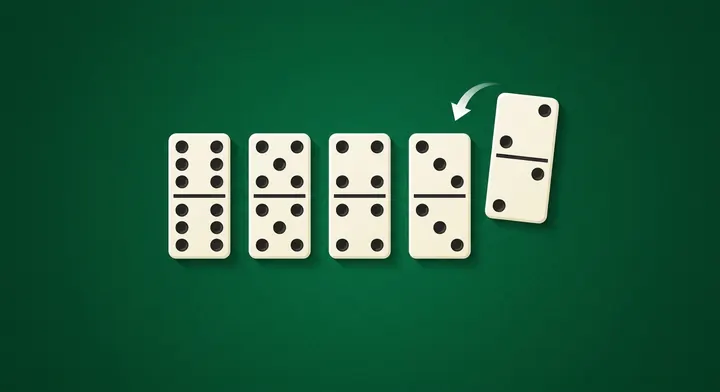
Matching ends
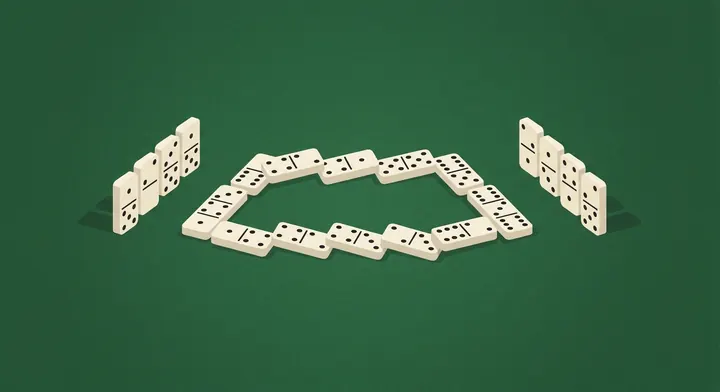
Tiles are added to either end of a single line, and the touching halves must match - Sixes on sixes, blanks on blanks.
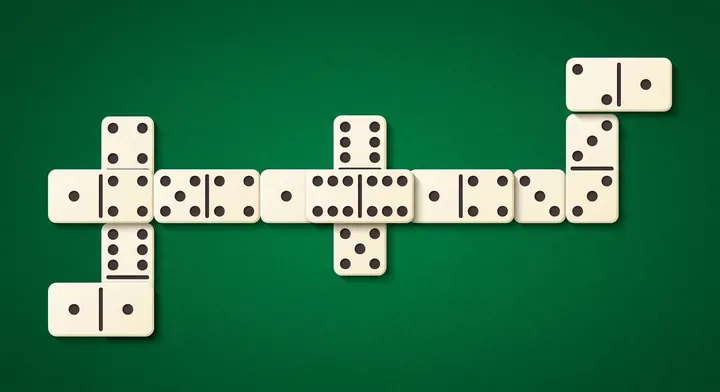
Doubles
Doubles are laid crosswise across the line for visibility, but they count as a single end of their number and open no new directions.
Blocked games
If you cannot play, you pass. When both players are stuck the hand is blocked, both hands are turned up, and the lower pip count wins.
History of Block
Block is widely treated as the primal form of European dominoes: take the twenty-eight tiles that appeared in eighteenth-century Italy and France, deal a hand to each player, and match ends until someone goes out or nobody can move. Early descriptions of the European game are essentially descriptions of Block, with the boneyard draw arriving as a later, gentler refinement.
The game's modern heartland is the Caribbean and Latin America. Carried across the Atlantic during the colonial era, dominoes took root in Cuba, the Dominican Republic, Puerto Rico, Venezuela and Jamaica, where the four-player partnership block game became a social institution - Played fast and loud, tiles slammed down with theatrical force, and results argued over long after the last hand. Regional and world championship events today are built on these block traditions.
Block's endurance comes from its purity. With no drawing and fourteen tiles asleep, every hand is a compact exercise in deduction: passes reveal gaps, played tiles shrink the possibilities, and the endgame often turns on whether a player steered the line toward a lock at the right moment. It is the version many serious players consider the truest test of domino skill.
How to Win Block: Strategy
💡 Top tip: Count pips from the very first move - Blocked hands go to the lighter holding, so treat every heavy tile in your hand as a debt to pay down early.
Winning tips, in order of importance
- Play doubles the moment they fit; with no boneyard, a stranded double can single-handedly lose you the count.
- Note every pass: it tells you your opponent holds neither open end, and that knowledge only grows more valuable as the hand shrinks.
- Keep the ends on numbers you are strong in - If you hold four tiles of a suit, only three others exist between your opponent's hand and the sleeping pile.
- With fourteen tiles out of play, never assume a missing number sits in your opponent's hand; it may be asleep, so plan for both cases.
- If your hand is light, steer toward a block; if it is heavy, keep the line open and race to go out.
- Save a tile that plays on both current ends for as long as you can - It is your insurance against being locked out.
Advanced tactics for Block
- Build a mental map of all seven tiles in each suit: what you hold plus what is on the table sets a hard ceiling on what your opponent can have.
- When your opponent passes on an end, own that number: returning the line to it again and again taxes them a pass every round while you keep playing.
- Count outs, not just pips, in the endgame: work out who runs dry of safe plays first and choose between racing and blocking accordingly.
- Give up a controlling play to shed the 6-6 or 6-5 when a block looms - The ten or more pips you unload usually outweigh the position you give away.
- The double-block is the sharpest weapon in the game: leave both ends on a number whose remaining tiles are all accounted for, and the hand ends on your terms.
- Late in the hand, reconstruct your opponent's exact tiles from their passes and plays; with only a few unseen tiles, the deduction is often complete.
- Plan your last three tiles as a unit: check that your intended out cannot be cut off by a single end change, and keep a backup exit on the other end.
Common Block mistakes to avoid
- Keeping a heavy hand for later - with no boneyard rescue, every pip you hold is a liability when the line locks, so shed big tiles early.
- Letting one number vanish from your hand - if both ends show a value you no longer hold, you are spectating while your opponent plays out.
- Passing information for free - a pass tells your opponent exactly which numbers you lack, so avoid plays that force your own future pass.
- Blocking the game while holding more pips - only steer the board toward a lock when a quick count says the lower total is yours.
Block Variations
Draw Dominoes
Block with a rescue: draw from the boneyard until you can play. Hands end by going out far more often, and the deduction loosens accordingly.
Partnership Block
The standard game of the Caribbean: four players in fixed pairs, all 28 tiles dealt, and table talk strictly forbidden. Reading your partner's plays becomes as important as reading your opponents'.
Latin point Block
Widespread across Cuba, the Dominican Republic and Venezuela: the winning side banks the losers' combined pips and matches run to 100 or 200 points, turning single hands into a long race.
Blind Hughie
A Scottish luck-leaning relative in which tiles stay face down in rows and are flipped and played in order - Barely any decisions, pure suspense.
Tiddle-a-Wink
A convivial family variant where playing a double earns the right to play again immediately, speeding the game up and rewarding double-heavy hands.
Block FAQ
How is Block different from Draw Dominoes?
There is no drawing in Block. Each player gets seven tiles, fourteen stay out of play, and if you cannot match either open end you pass. That single change makes deduction and pip management far more important, because no fresh tiles ever arrive to bail you out.
Who wins a blocked hand?
When both players are stuck the hand is over: hands are revealed, pips are counted, and the lower total wins. This is why the 6-6 is the most dangerous tile in the game to be caught holding.
What happens to the tiles that aren't dealt?
Fourteen tiles stay face down and never enter play. They are often called the sleeping tiles, and they add a layer of uncertainty: a number missing from the table might be in your opponent's hand or asleep, and strong players weigh both possibilities.
Can I pass on purpose in Block Dominoes?
No - In standard rules you must play if you hold a tile that matches an open end. Passing only happens when you are genuinely stuck, which is precisely why a pass leaks so much information to a watchful opponent.
Why do players count pips in Block?
Because a large share of hands end blocked rather than played out, and the pip count then decides the winner. Every heavy tile you carry - The 6-6, 6-5 or 5-5 - Is a liability the moment the line threatens to lock.
What is the best opening play in Block?
Leading a double from your strongest suit is the classic choice: it sheds a tile that can only ever match one number while steering the line toward a suit you control. Leading your heaviest tile is a solid alternative when a block looks likely.
How do I block the game on purpose?
Steer both open ends to the same number once most of that suit has been played. If all seven tiles of a suit are accounted for and both ends show it, nobody can move and the hand ends immediately - A devastating finish when your pip count is the lower one.
Is Block Dominoes older than Draw?
The block principle is the simpler of the two, and most historians treat it as the base form of European dominoes, with the Draw game essentially adding a rescue mechanism. By the nineteenth century, rulebooks were describing the two side by side.
Why is Block so popular in the Caribbean and Latin America?
The game arrived with Europeans and settled deep into everyday culture in Cuba, the Dominican Republic, Puerto Rico, Venezuela and Jamaica, where dominoes is a loud, fast social institution. The four-player partnership version of Block remains the standard game across the region, played everywhere from kitchen tables to national championships.
What does it mean to be locked out of a suit?
It means the ends show numbers you cannot match, and with no boneyard you can only pass while your opponent plays on. Avoiding lockout - By keeping at least one tile for every live number as long as possible - Is a core Block skill.
Do doubles have special powers in Block?
No. A double is laid crosswise for visibility but counts as a single end of its number, and there is no spinner. Its real significance is tactical: it can only ever match one number, so a stranded double is a common way to lose the pip count.
How many tiles of each number are in the set?
Every number from blank to six appears on exactly seven tiles in a double-six set. Counting how many of a number have hit the table - And how many you hold - Tells you the maximum your opponent can have, which is the engine of Block deduction.
Still have a question about Block Dominoes? Browse the full dominoes FAQ, look up a term like classic or simple & pure in the dominoes glossary, or compare Block with the other games in the rules for every dominoes game.
Last updated .