Draw Dominoes with a boneyard to fall back on
The classic starter - Match ends, draw from the boneyard when stuck, first out wins.How to Play Draw Dominoes
In a nutshell: The classic starter - Match ends, draw from the boneyard when stuck, first out wins. You play with a double-six set (28 tiles), it's rated the beginner's game, and roughly even vs the computer - tile reading tips the balance.
Draw Dominoes is the game most people learn first - The plain, friendly heart of the whole domino family. Each player takes seven tiles from the double-six set, the rest go face down into the boneyard, and you take turns adding tiles to either end of a growing line, matching pips to pips. Can't play? You draw from the boneyard until you can, which keeps the game moving and punishes a hand that runs out of options. The first player to place their last tile wins; if the line locks up with nobody able to play, the lighter hand takes it. Beneath the simple rules sits real judgment: which end to feed, which suits to keep covered, and when a forced trip to the boneyard tells you exactly what your opponent does not hold.
Draw at a glance
| Goal | Be the first to play every tile in your hand. Win the hand outright, or hold the lighter hand if the line blocks. |
|---|---|
| Set used | Double-six - 28 tiles in play |
| Players | 2 - You vs the computer, or a friend online |
| Difficulty | The beginner's game |
| Chance of winning | Roughly even vs the computer - Tile reading tips the balance |
| Family | Classic |
Step by step
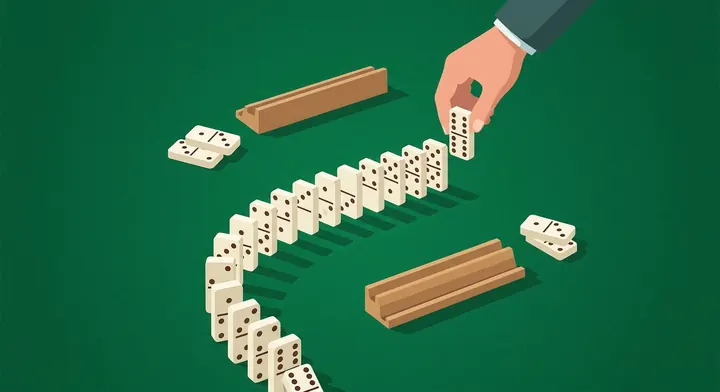
Goal
Be the first to play every tile in your hand. Win the hand outright, or hold the lighter hand if the line blocks.
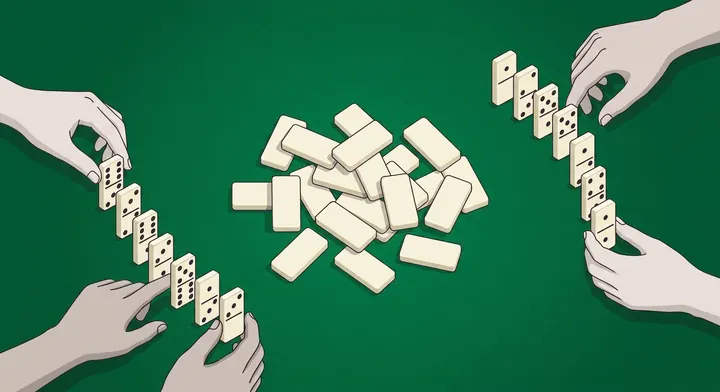
The deal
Each player draws seven tiles from the shuffled double-six set of 28; the remaining fourteen go face down into the boneyard.
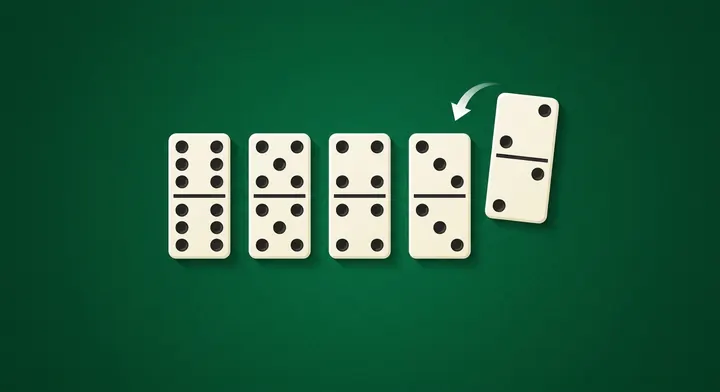
Matching ends
The line grows at both ends. A tile may be played only where one of its halves matches the pip count of an open end - A 6-3 can join an open six or an open three.
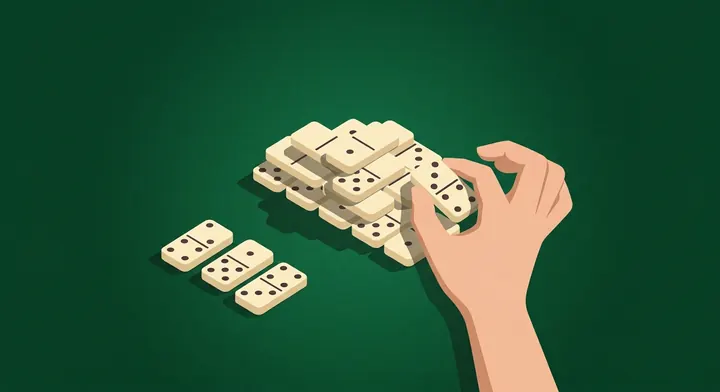
The boneyard
If you have no playable tile, draw from the boneyard until you find one. You may pass only when the boneyard is empty.
Going out
The first player out of tiles wins. If neither player can move and the boneyard is gone, the hand is blocked and the lower pip count wins.
History of Draw
The dominoes we play with are descendants of Chinese tile games recorded around the Song dynasty, in which bone tablets represented the throws of two dice. The European set is a later and distinct invention: twenty-eight tiles including blanks, first noted in eighteenth-century Italy and France. From there the game crossed to Britain - It is often said via French prisoners of war during the Napoleonic era, a story that is plausible if hard to prove - And on to the wider world.
The Draw game is the base form described in virtually every rulebook since: match the open ends, draw from the leftovers when stuck, and go out first. The tiles' old nicknames tell their material history - 'Bones' and 'ivories' recall the days when dominoes were cut from animal bone or ivory with ebony backs - While the name domino itself most likely borrows from the black-and-white hooded costume worn at masquerades.
Because the rules travel so lightly, Draw became a genuinely global game: a fixture of cafes, kitchen tables and barracks on every continent, the version parents teach children, and the foundation on which the scoring and blocking variants were built. Digital play has only widened its reach, and it remains the natural first stop for anyone learning dominoes.
How to Win Draw: Strategy
💡 Top tip: Play your doubles early - A double matches only one number and becomes harder to place with every turn that passes.
Winning tips, in order of importance
- Keep at least one tile of every suit for as long as you can, so you are never forced into a long boneyard draw.
- Lead from your strongest suit: the more tiles of a number you hold, the more you control the ends that show it.
- Shed heavy tiles - The 6-6, 6-5 and 5-5 - While the line is open, because they decide blocked hands against you.
- Watch what your opponent draws: every boneyard trip means they could cover neither open end, which narrows their hand sharply.
- Count each suit as it appears: only seven tiles carry each number, and when six are on the table you know exactly where the last one can go.
- Steer both ends toward numbers you hold and away from numbers you have already seen your opponent play happily.
Advanced tactics for Draw
- Track the remaining count of every suit, not just the ends: knowing three sixes are still unseen tells you how safe a six-ended line really is.
- Force draws deliberately: setting both ends to a suit your opponent has shown weakness in can send them to the boneyard three or four tiles deep.
- A drawn tile is information for both players - When you must draw, remember your opponent now knows you lacked both end values at that moment.
- Late in the hand, count pips as well as tiles: if a block is coming, dumping one heavy tile can flip the result even when it costs you tempo.
- Keep a flexible tile - One whose two halves are both live suits - As your final tile, so your out cannot be cut off by a single end change.
- When the boneyard runs low the game quietly turns into Block: stop relying on rescues and start engineering the lock while your pip count is the lighter one.
- Prefer plays that leave the two ends on different numbers: distinct ends double the chance your next tile fits, while matched ends narrow everyone's options including yours.
Common Draw mistakes to avoid
- Drawing without a plan - before you touch the boneyard, note which end values you could unlock, or you will pull half the pile for nothing.
- Spending your doubles late - doubles only fit one number, so play them the moment their number is open instead of hoarding them.
- Emptying your hand of one suit - keep at least one tile of the values showing on the ends, or a single blocked turn snowballs.
- Ignoring what your opponent draws - every draw tells you which numbers they lack, so steer the ends toward those numbers.
Draw Variations
Block Dominoes
The same game with the boneyard removed: pass when you cannot play, and let the pip count settle blocked hands. Sharper deduction, less forgiveness.
All Fives
Adds live arithmetic to the draw game: score whenever the open ends total a multiple of five, with the first double serving as a four-armed spinner.
Cross Dominoes
Opens with a double and builds a four-armed cross before normal play resumes, multiplying the open ends from two to four.
Double-nine Draw
A 55-tile set with pips up to nine supports bigger hands and more players while leaving the rules untouched - A common family choice.
Three- and four-hand Draw
With more players each usually takes five tiles, leaving a deeper boneyard; four-player games are often organized as fixed partnerships instead.
Draw FAQ
How many tiles do you start with in Draw Dominoes?
In the two-player game each player draws seven tiles from the shuffled double-six set of 28. The remaining fourteen tiles go face down into the boneyard, ready to be drawn when someone cannot play.
What is the boneyard?
The boneyard is the pool of face-down tiles left over after the deal. When you have no tile matching either open end, you draw from it until you find one you can play. The name comes from 'bones', the old nickname for domino tiles, which were once made from bone and ivory.
What happens when the boneyard is empty?
Once the boneyard runs out, a player who cannot match either end simply passes. If both players pass in turn, the hand is blocked, both hands are revealed and the lower pip count wins.
Do I have to play a tile if I can?
Yes. In standard Draw rules you must play when you hold a matching tile; you only draw when genuinely stuck. This keeps the game honest - You cannot draw speculatively to fish for a better tile.
How do doubles work in Draw Dominoes?
A double is traditionally laid crosswise across the line so it is easy to spot, but it behaves like any other tile: it counts as a single end of its number and opens no extra directions. There is no spinner in the basic Draw game.
Who wins a blocked game?
When neither player can move and the boneyard is empty, both hands are turned face up and the pips are counted. The player with the lower total wins the hand, which is why experienced players shed their heaviest tiles early.
What is the difference between Draw and Block Dominoes?
The only structural difference is the boneyard. In Draw you must draw tiles until you can play; in Block there is no drawing at all and you simply pass. Draw hands usually end with someone going out, while Block hands are decided by the pip count far more often.
Is Draw Dominoes the standard dominoes game?
Effectively yes. When rulebooks describe 'dominoes' without a qualifier they usually mean the Draw game, and it is the version most people learn first. Nearly every other variant - From All Fives to Matador - Is built on its match-the-ends foundation.
What is a good first tile to play?
Many players lead their heaviest tile or their strongest double, and both ideas have merit: leading heavy sheds pips in case of a block, while leading from your longest suit pulls the line toward numbers you control. Leading a lone tile in a suit you barely hold is the play to avoid.
What does 'pip' mean in dominoes?
Pips are the spots on each half of a tile, running from zero - A blank - Up to six in a double-six set. Pip count, the sum of all spots in a hand, decides blocked games, so heavy tiles like the 6-6 are a standing risk.
Can the line be played at both ends?
Yes, the layout is a single line with two open ends, and every tile must match one of them. Reading which end to feed - And which numbers to keep alive there - Is most of the strategy in Draw.
How long does a game of Draw Dominoes take?
A single hand usually takes just a few minutes, which is part of the game's charm. Many players run a series of hands and keep a running score, but the classic Draw game is decided hand by hand.
Still have a question about Draw Dominoes? Browse the full dominoes FAQ, look up a term like classic or the beginner's game in the dominoes glossary, or compare Draw with the other games in the rules for every dominoes game.
Last updated .