Matador Dominoes: make the ends add to seven
Forget matching - Adjacent ends must add to seven, and matadors are wild.How to Play Matador Dominoes
In a nutshell: Forget matching - Adjacent ends must add to seven, and matadors are wild. You play with a double-six set (28 tiles), it's rated nothing matches - it adds, and even odds - matador timing is everything.
Matador turns the fundamental rule of dominoes on its head: instead of matching an open end, your tile's touching half must add to seven with it, so a 4 needs a 3, a 6 needs a 1, and nothing at all plays on a blank. Nothing, that is, except the four matadors - The 0-0, 1-6, 2-5 and 3-4 - Wild tiles that can be played on any end at any time, whichever way round you choose. Doubles lie flat in the line like any other tile, there is no spinner, and when you cannot play you draw from the boneyard. The hand is won by going out first, or by holding fewer pips when the line blocks. Because blank ends act as locks and matadors as the only keys, the whole game revolves around when to spend those four precious tiles.
Matador at a glance
| Goal | Play out your hand first, or hold fewer pips when the line blocks - But here the touching ends must add to seven, not match. |
|---|---|
| Set used | Double-six - 28 tiles in play |
| Players | 2 - You vs the computer, or a friend online |
| Difficulty | Nothing matches - It adds |
| Chance of winning | Even odds - Matador timing is everything |
| Family | Twist Variants |
Step by step
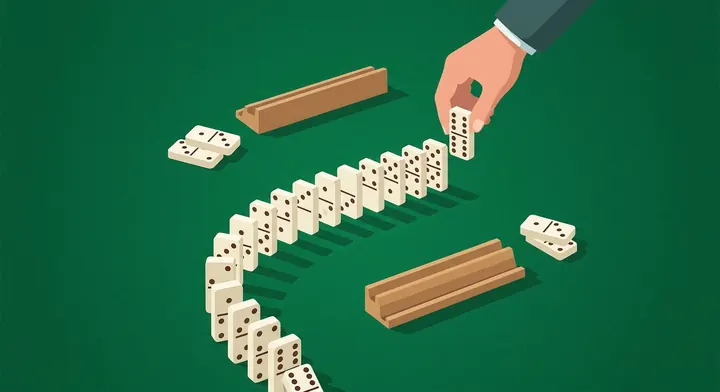
Goal
Play out your hand first, or hold fewer pips when the line blocks - But here the touching ends must add to seven, not match.
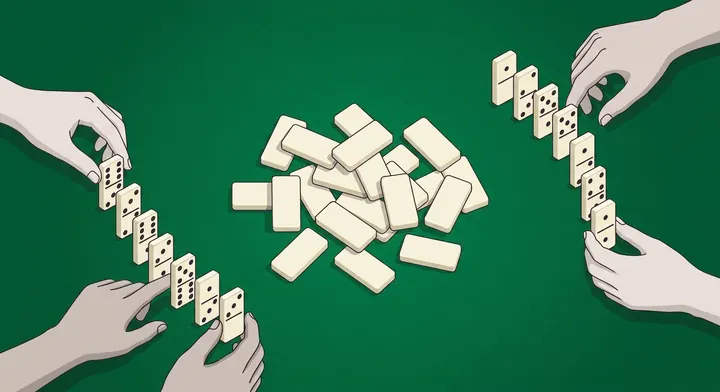
The deal
Each player draws seven tiles from the double-six set; the rest form the boneyard, drawn from whenever you cannot play.
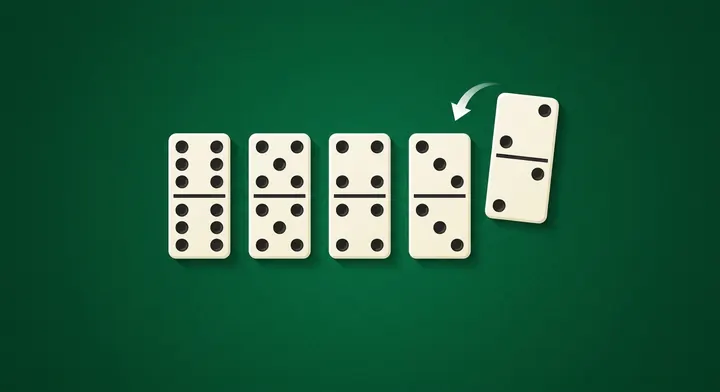
Ends that add to seven
A tile may be played only where its touching half and the open end sum to seven - A 3 plays on a 4, a 1 on a 6. No ordinary tile plays on a blank.
The matadors
The 0-0, 1-6, 2-5 and 3-4 are matadors: wild tiles playable on any end at any time, with either half left facing out. They are the only tiles that can rescue a blank end.
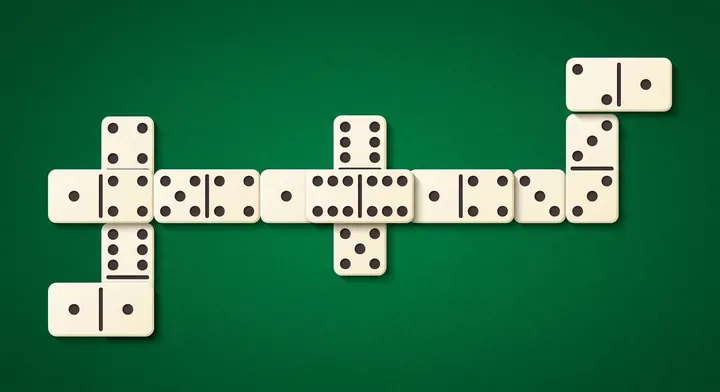
Doubles
Doubles lie inline like any other tile and expose only one half - There is no spinner and no crosswise play in Matador.
History of Matador
By the nineteenth century the European domino set had spawned a family of deliberate rule inversions, and Matador is the most enduring of them. Instead of matching ends, tiles connect where the touching halves total seven - A complete rethinking of the game's basic reflex that compilers of game books found irresistible, listing it under names like Matador, All Sevens and, in some collections, Russian Dominoes.
The Spanish name - Matador, the killer, the bullfighter who ends the contest - Attaches not to the game's birthplace but to its four wild tiles, which alone can strike into a blank end. Where the game actually originated is unrecorded; it circulated widely in continental Europe, with German and Scandinavian compendiums giving it particular attention, and crossed into English-language rulebooks by the late nineteenth century.
Matador has never rivalled the block games' mass appeal, but it has held a devoted niche for well over a century. Its admirers prize exactly what makes it strange: blanks that lock the line, arithmetic in place of matching, and a four-tile resource whose timing decides most hands. Among traditional variants it remains the standard answer to the question of what dominoes feels like with its central rule turned inside out.
How to Win Matador: Strategy
💡 Top tip: Spend your matadors like trump cards - They are the only tiles that play on a blank end, so burning one while ordinary plays exist can cost you the hand.
Winning tips, in order of importance
- Blanks are weapons: steering an end to a blank locks it against everything but a matador, and can send an unprepared opponent digging through the boneyard.
- Retrain your eye to complements: an open 4 calls for your threes and an open 6 for your ones - Read your hand in sums, not matches.
- Place doubles early - Each one fits only a single end value, so a stranded double is even more awkward here than in the matching games.
- Keep at least two different sums covered late in the hand, because drawing until you can play makes a bad position bleed tiles fast.
- Every ordinary blank tile - The 0-1 through 0-6 - Plays only one way and always leaves a blank end behind; hold them for the moment a lock hurts your opponent most.
- Count pips late: the hand can block like any draw game, and matadors held too long - Especially the 3-4 and 2-5 - Become dead weight in the final count.
Advanced tactics for Matador
- Play matadors with intent about orientation: the exposed half sets the next required sum, so choose the side that points the game toward tiles you still hold.
- Blank ends block you too - Before locking an end, confirm your own hand can live on the ends that remain, or you may be the one sent to the boneyard.
- The 0-0 is a lock that plays anywhere: as a matador it lands on any end and instantly seals it with a blank - The purest blocking move in the game.
- Deduce hands through sums: an opponent who draws against an open 3 holds no fours and chose not to spend a matador - Both facts matter later in the hand.
- Manage the four matadors as a global resource: track how many have been played, because the last unplayed matador controls every blank end in the endgame.
- A double fixes the same demand twice: the 4-4 leaves an end wanting a three both before and after it is covered on one side - Use doubles to park an end on a sum you monopolize.
- In a blocked-game count matadors are heavy - The 3-4 and 2-5 carry seven pips apiece - So in a closing race, shed them even when a cheaper play exists.
Common Matador mistakes to avoid
- Matching numbers out of instinct - ends connect by summing to seven here, so a 4 needs a 3, not another 4.
- Spending matadors early - the four wild tiles (0-0, 1-6, 2-5, 3-4) are your only escape from a blank end, so hold them for emergencies.
- Ignoring blanks - a blank end can only be covered by a matador, so forcing blanks onto the board when you hold matadors is a winning squeeze.
- Reading doubles as crosswise - doubles lie inline in Matador and only one half counts, so a 6-6 end needs a 1, not a 6.
Matador Variations
Double-nine Matador
With pips up to nine the target sum becomes ten, and the matadors change to the double blank plus every tile totalling ten - The 4-6 and 5-5 among them. Same logic, bigger arithmetic.
Block Matador
Played without a boneyard: knock and pass when you cannot make seven. The matadors and blanks grow even stronger when no fresh tiles can rescue a locked player.
Four-player Matador
Smaller deals accommodate a full table, and with four hands hunting the same four matadors, blank ends dominate the midgame.
All Sevens
The same game under its plainer name in some rulebooks, stressing the adding rule rather than the wild tiles; a few versions tweak how doubles may be placed.
Series play
Rather than a single hand, many tables run a series in which the winner banks the loser's leftover pips and the first to an agreed total - Often 100 - Takes the match.
Matador FAQ
What is a matador?
A matador is one of the four tiles whose pips total seven - The 1-6, 2-5 and 3-4 - Plus the double blank. Matadors are wild: they may be played on any open end at any time, whichever way round you like, and they are the only tiles that can be played against a blank.
Why do the ends add to seven instead of matching?
That inversion is the whole game. A tile joins the line only where its touching half and the open end sum to seven, so an open 4 wants a 3, an open 6 wants a 1, and an open blank wants a seven - Which does not exist, locking the end to everything but a matador.
Why can't anything be played on a blank?
Because no half carries seven pips, no ordinary tile sums to seven with a blank. A blank end is effectively frozen, and only a matador - Played by its wild-card privilege rather than by arithmetic - Can reopen it. Steering ends to blanks is the game's main aggressive weapon.
How do doubles work in Matador?
Doubles lie inline like every other tile - There is no spinner and no crosswise placement. A double is played where its pip complements the end to seven and it leaves its own value exposed, so the 4-4 lands on an open 3 and leaves a 4 that demands another 3.
Which way round should I play a matador?
Your choice, and it matters: the half you leave exposed sets the new end value and therefore the sum the next tile must make. Dropping the 2-5 with the 5 out demands twos from the table; with the 2 out it demands fives. Pick the side your remaining hand can feed.
What happens if I can't play in Matador?
You draw from the boneyard until you can, passing only once it is empty. Since blank ends drastically shrink what counts as playable, a well-timed blank can send your opponent digging deep while you sit comfortably on a matador.
How does a hand of Matador end?
As in the draw game: someone plays their last tile, or the line blocks with the boneyard empty and no legal plays. First out wins; in a blocked hand the lower pip count takes it - And beware, unplayed matadors like the 3-4 carry a heavy seven pips each.
Are the blank tiles useless in Matador?
Far from it - They are the game's blocking specialists. An ordinary blank tile such as the 0-3 can only enter play through its numbered half, and it always leaves a blank end behind, sealing that end against everything but a matador. Held for the right moment, they are as strategic as the matadors themselves.
Where does the name Matador come from?
Matador is Spanish for 'killer' - Familiar as the bullfighter who delivers the final stroke - And here it names the four tiles that can break into any end. The variant itself appears in European game collections from the nineteenth and twentieth centuries, popular especially on the continent, though exactly where it was invented is not reliably recorded.
Is Matador harder than regular dominoes?
The mechanics take one game to absorb and a few more to internalize - New players instinctively match instead of adding. Once complements-to-seven become second nature, the deeper challenge emerges: timing your matadors and managing blank ends, which gives Matador more bite than Draw or Block.
How many tiles do you start with?
Seven each from the double-six set of 28, with the rest forming the boneyard - The same shape as the classic draw game. All the difference lies in how tiles connect, not in how they are dealt.
Can I play a matador even when I have an ordinary play?
Yes, matadors may be played at any time, not just as a rescue. Sometimes the best move is spending one early to fix an end on a value you monopolize. Just remember there are only four in the whole set, and the player holding the last one controls every blank in the endgame.
Still have a question about Matador Dominoes? Browse the full dominoes FAQ, look up a term like twist variants or nothing matches - it adds in the dominoes glossary, or compare Matador with the other games in the rules for every dominoes game.
Last updated .