Fives and Threes, the British pub game
The British pub game - Score for fives AND threes, race exactly to 61.How to Play Fives and Threes
In a nutshell: The British pub game - Score for fives AND threes, race exactly to 61. You play with a double-six set (28 tiles), it's rated the pub classic, and the better counter wins most races to 61.
Fives and Threes is the great British pub game - The variant played in leagues across northern England, traditionally scored on a cribbage board. Every play is measured against both targets at once: if the two open ends total a multiple of five you score a point per five, a multiple of three pays a point per three, and the magic total of 15 pays both at once for eight points, the game's famous maximum. Each player takes nine tiles, ten stay sleeping face down, and there is no drawing and no spinner - Just a single line, a knock when you are stuck, and a race to 61 points across as many hands as it takes. Because points come in ones, twos and threes, every single placement matters, and the best players calculate two moves deep before letting a tile touch the table.
5s & 3s at a glance
| Goal | Be the first to reach 61 points, scored across as many hands as it takes, by making the two open ends divide by five, by three, or by both. |
|---|---|
| Set used | Double-six - 28 tiles in play |
| Players | 2 - You vs the computer, or a friend online |
| Difficulty | The pub classic |
| Chance of winning | The better counter wins most races to 61 |
| Family | Scoring Games |
Step by step
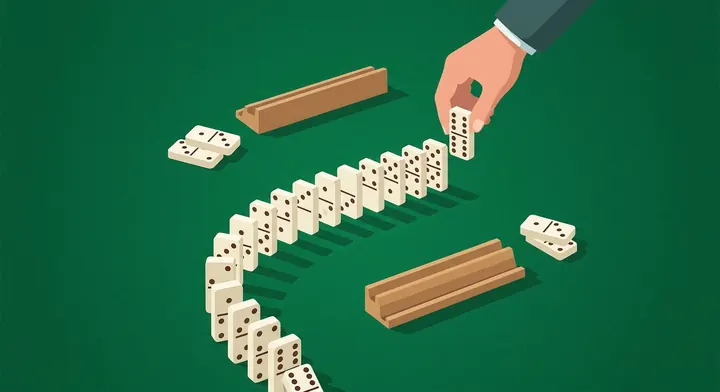
Goal
Be the first to reach 61 points, scored across as many hands as it takes, by making the two open ends divide by five, by three, or by both.
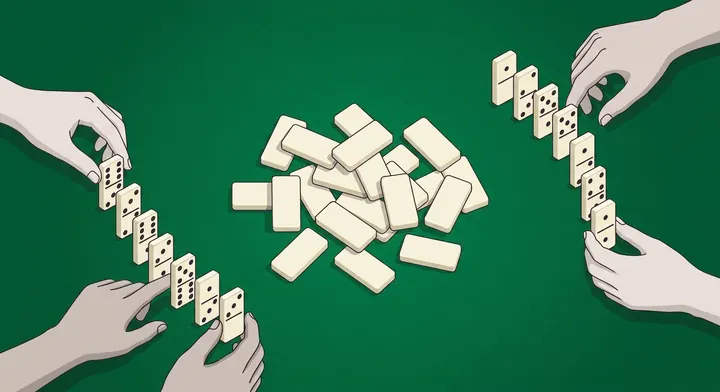
The deal
Each player takes nine tiles from the double-six set; the remaining ten sleep face down and are never drawn.
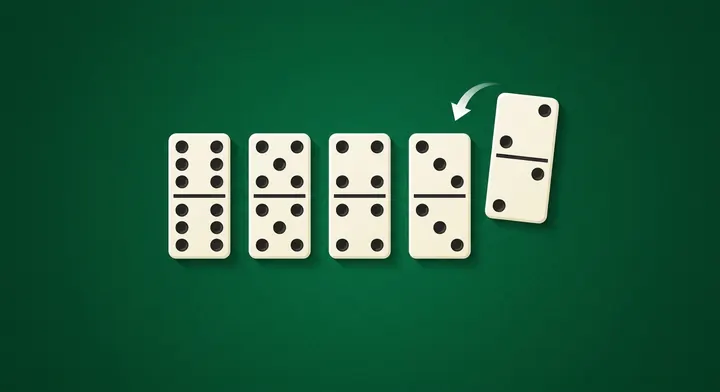
Matching ends
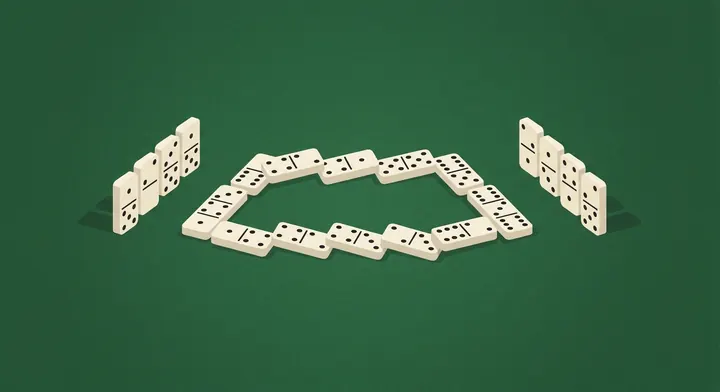
There is one line and no spinner. Tiles match end to end exactly as in Block, and if you cannot play you knock and pass.
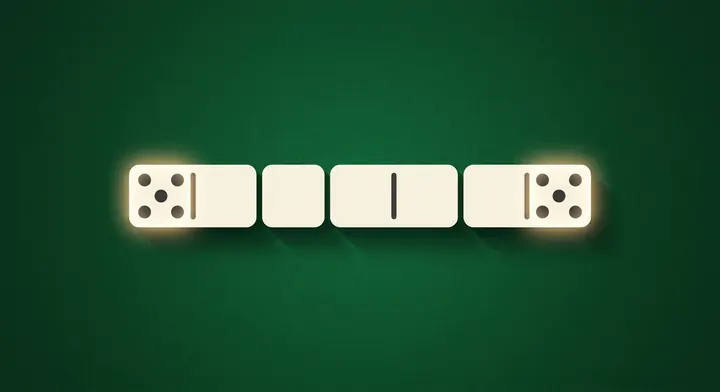
Scoring
Add the two open ends: a multiple of five scores one point per five, a multiple of three one point per three. Fifteen divides by both and pays eight - The maximum. A double at an end counts both halves.
Blocked games
A hand ends when someone plays their last tile or when both players knock in succession; then a fresh hand is dealt and the race to 61 continues.
History of 5s & 3s
Dominoes reached Britain in the late eighteenth century, according to tradition partly through French prisoners of war who carved sets and taught the game, and it settled quickly into taverns and working men's clubs. There the plain block game met the British fondness for pegged scoring, and the counting variants began to flourish alongside darts and cribbage.
Fives and Threes is the refinement that stuck. By scoring a point per five and per three in the total of the two ends - Rather than the whole total, as Muggins does - It produced small, constant scores that fit a cribbage board perfectly, and 61, once around the board, became the standard race. Pub leagues across northern England and the Midlands adopted it as their competition game, often in pairs, with fixtures, league tables and championship nights that continue to this day.
While the great wave of pub games has receded, 5s and 3s has proved stubborn. It remains one of the few domino games with an organized league culture, and its reputation among players is that of the thinking person's dominoes: a game where the tiles are dealt by luck but 61 is reached by arithmetic, patience and nerve.
How to Win 5s & 3s: Strategy
💡 Top tip: Learn the paying totals cold: 3 and 5 pay one, 6 and 10 pay two, 9 pays three, 12 and 20 pay four, 18 pays six, and 15 - The double six beside a three - Pays the maximum eight.
Winning tips, in order of importance
- Guard the fifteen-makers: the 6-6 needs a three at the far end and the 5-5 a five, so protect the partners as carefully as the doubles themselves.
- Watch the knocks: with ten tiles sleeping and no drawing, every pass names two numbers your opponent cannot cover.
- Score little and often - A steady stream of ones and twos to 61 beats waiting for a single eight that may never come.
- Doubles count both halves at an end, which is the only route to the big totals; place them where they pay you, not your opponent.
- Think one reply ahead: a two-point play that leaves your opponent an easy three is a one-point loss, not a gain.
- When you cannot score, spoil - Shift the ends to totals that none of the likely tiles can convert cheaply.
Advanced tactics for 5s & 3s
- Work both moduli at once: a total of 8 is one away from 9 and two away from 10, so read every possible end change against division by three and by five simultaneously.
- Playing a tile changes one end from a to b, shifting the total by the difference - List the shifts your hand can produce and match them against the paying totals before every turn.
- The famous eight is usually set up a move earlier: look for plays that leave a three exposed while you still hold the double six, and deny your opponent the mirror-image setup.
- Treat the run-in to 61 like a cribbage race: track both scores, and shape hands so your winning total arrives on a play you control - Strict tables require landing on 61 exactly.
- Knocks are gold with ten tiles sleeping: two knocks against the same end values all but names your opponent's hand, so keep the line there while you score elsewhere.
- Track the scoring tiles themselves: only a handful of tiles can create fifteen or eighteen, and once the 6-6 and 5-5 are down, the ceiling on every future play drops sharply.
- When you lead the race, a blocked hand is your friend - It wipes out your opponent's scoring chances for the deal - So lock the line when the count favors you.
Common 5s & 3s mistakes to avoid
- Missing the fifteens - a board total of 15 pays both ways (three fives and five threes) for 8 points, the biggest single play in the game.
- Racing to 61 without landing spots - the last few points matter most, so keep tiles that can still make small scores late in the game.
- Treating it like All Fives - there is no spinner and no drawing here, so every tile you burn early is tempo you cannot buy back.
- Ignoring the double at the end - an end double counts both halves toward the total, turning a 6-6 into 12 and rewriting the arithmetic.
5s & 3s Variations
All Fives (Muggins)
The American counting classic: score the whole end total when it divides by five, with a spinner and pip payouts for winning hands - Bigger swings than the pub game.
All Threes
The counting game tuned to threes alone, scoring the full total rather than points per division - A halfway house between Muggins and 5s and 3s.
Partnership Fives and Threes
The league standard in many pubs: two fixed pairs pooling their scores and pegging to 61 on one cribbage board, the format used in most organized competition.
Different targets
Quick matches run to 31 and marathon ones to 121, but 61 - Once round a cribbage board - Remains the league standard.
Exact-finish rules
Strict league play requires landing on 61 exactly, with overshooting scores ignored; friendlier tables let any score reaching 61 win. Agree before you peg.
5s & 3s FAQ
How does scoring work in Fives and Threes?
Add the two open ends after your play. If the total divides by five you score one point per five; if it divides by three, one point per three; if it divides by both, you score both. So 10 pays two points, 9 pays three, and 15 pays three plus five for eight.
Why is 15 worth eight points?
Fifteen divides by both targets: as three fives it pays three points, and as five threes it pays five, for eight in all. The classic way to make it is the double six at one end with a three at the other, since a double counts both its halves.
Why do you play to 61?
The game grew up in British pubs where scores were pegged on a cribbage board, and 61 - Once around the board and into the game hole - Became the standard target. That inheritance also explains the game's rhythm of small, frequent scores.
Do I need to land on 61 exactly?
In strict league play, yes - A score that would carry you past 61 is ignored, so a player on 59 needs exactly a two. Friendlier games often relax this and simply award the win to the first player to reach 61. Either way, shaping your endgame scores is part of the craft.
Why nine tiles each?
The two-player game deals nine tiles apiece, leaving ten sleeping face down that are never drawn. Bigger hands give each player more scoring chances per deal, and the ten unseen tiles keep deduction honest - A missing tile may be asleep rather than in your opponent's hand.
Is there a spinner in Fives and Threes?
No. The layout is a single line with exactly two open ends, which keeps the arithmetic crisp: every score is simply the sum of two numbers. Doubles are laid crosswise for visibility but count both halves at an end, which is the route to the biggest totals.
What happens when I can't play?
You knock - The traditional term for passing - And your opponent plays on. There is no drawing in Fives and Threes. When both players knock in succession the hand is dead, a fresh hand is dealt, and the race to 61 carries on.
What is the highest possible score in one play?
Eight points, scored when the ends total fifteen: the double six beside a three, or the double five with a five at the far end. The next best are eighteen - The double six with a six - For six points, and twenty, the double six facing the double four, for four.
Is Fives and Threes the same as Muggins?
No. Muggins - All Fives - Scores the full end total when it divides by five and uses a spinner, while Fives and Threes scores points per division against both five and three, with no spinner and nine-tile hands. The British game is slower-scoring, tighter, and its devotees would say deeper.
Why is it called the pub game?
Fives and Threes - Often written 5s and 3s - Has been a fixture of British pub leagues for generations, especially across northern England, usually organized alongside darts and crib. League nights, pairs formats and cribbage-board scoring gave the game its enduring social home.
Does going out score anything?
Points chiefly come from the end totals, and in many traditions playing your last tile simply ends the hand; some leagues award a point or two for chipping out, so conventions vary. Whatever the table rule, going out early denies your opponent scoring turns, which is reward enough.
Is Fives and Threes a skill game?
Highly. The scores are small and constant, so the better calculator gains an edge on nearly every turn, and over a race to 61 those edges compound. Luck decides single deals, but the season-long league tables that pubs keep tend to show the same names at the top year after year.
Still have a question about Fives and Threes? Browse the full dominoes FAQ, look up a term like scoring games or the pub classic in the dominoes glossary, or compare 5s & 3s with the other games in the rules for every dominoes game.
Last updated .