Cross Dominoes on four open arms
Open with a double, build a cross, then race along four open arms.How to Play Cross Dominoes
In a nutshell: Open with a double, build a cross, then race along four open arms. You play with a double-six set (28 tiles), it's rated four arms, more choices, and near 50/50 - arm management separates players.
Cross Dominoes opens with a ritual: the first tile must be a double, and the next four plays all attach to it, one on each side, building a cross at the centre of the table. From then on the layout has four open arms, and every turn offers up to four different ends to serve - Or to poison. Draw from the boneyard when you cannot play, and go out first or hold the lighter hand at a block to win. The extra arms sound like extra freedom, but they cut both ways: four ends means four suits to keep alive, and a player who lets one arm die on a number they cannot cover hands the initiative straight to their opponent. Cross is the natural next step after Draw, and the gateway to the whole family of multi-arm domino games.
Cross at a glance
| Goal | Play out your hand first across a four-armed layout, or hold the lighter hand if the game blocks. |
|---|---|
| Set used | Double-six - 28 tiles in play |
| Players | 2 - You vs the computer, or a friend online |
| Difficulty | Four arms, more choices |
| Chance of winning | Near 50/50 - Arm management separates players |
| Family | Twist Variants |
Step by step
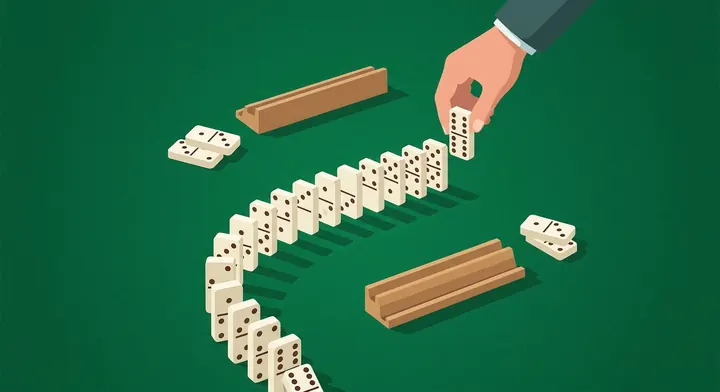
Goal
Play out your hand first across a four-armed layout, or hold the lighter hand if the game blocks.
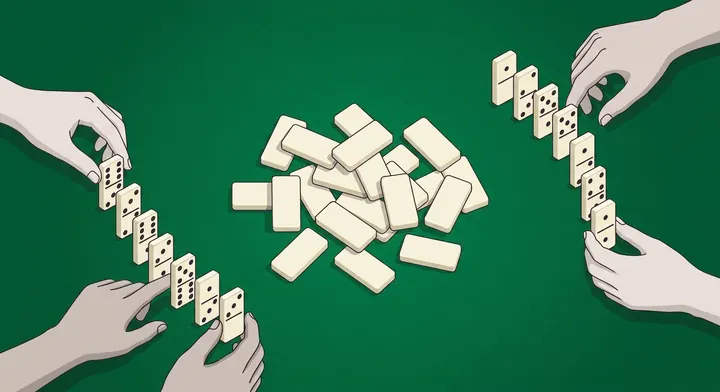
The deal
Each player draws seven tiles from the double-six set; the rest form the boneyard. The opening play must be a double.
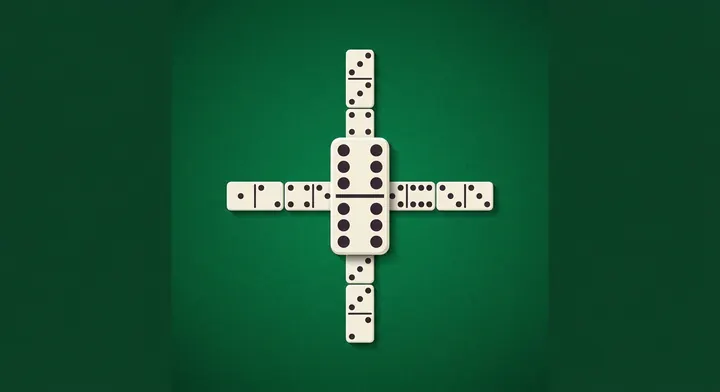
The cross
The next four plays all attach to the opening double, one on each of its four sides. Only when the cross is complete does normal play resume.
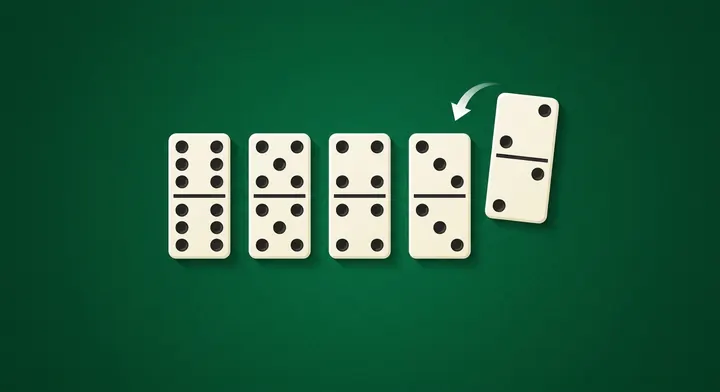
Matching ends
From then on tiles match end to end along all four arms, so every turn can offer up to four places to play.
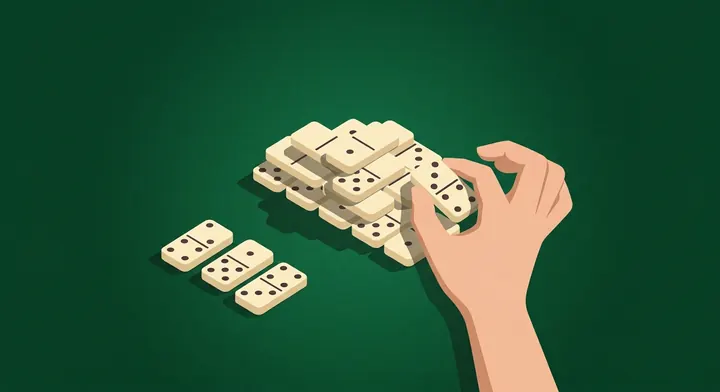
The boneyard
Cannot play on any arm? Draw from the boneyard until you can, and pass only once it is empty. First out - Or lighter at the block - Wins.
History of Cross
Once the plain line games were established in Europe, players began experimenting with the shape of the layout itself, and the radial games were the result. Cross - Open on a double, build out four ways, then play on every arm - Is the simplest and oldest of these elaborations, appearing in nineteenth-century game collections as a standard alternative to the straight line of Block and Draw.
Its best-known sibling carries a date in its name: Sebastopol, which fixes the hub on the double six, is generally taken to commemorate the siege of Sevastopol in the Crimean War of the 1850s, suggesting the family was well established by the Victorian era. Variants multiplied from there - Maltese Cross tightened the rules for growing the arms, Double Cross pushed the branching further - As compilers and players traded refinements.
The cross layout proved to be one of dominoes' most fertile ideas. Twentieth-century party games took the branching principle and ran with it: Chicken Foot makes every double sprout, and Mexican Train, a craze in the United States from the 1990s onward, hangs a whole personal train on each player. Anyone who learns Cross is learning the grammar of that entire modern family.
How to Win Cross: Strategy
💡 Top tip: Serve all four arms in your head every turn - The player who runs out of options on one arm first is usually the one who ends up in the boneyard.
Winning tips, in order of importance
- Choose your opening double from strength: the cross forms on its number, so lead a double in a suit where you hold support tiles.
- The cross phase demands tiles of the opening number; if your hand is thin there, expect early draws and plan the rest of the hand around them.
- Four arms mean more chances to place every tile, so dump your one-way doubles early and keep the flexible tiles for the endgame.
- Watch for arms that repeat a value: two ends showing the same number drain that suit twice as fast.
- Track opponent draws closely - A draw means they could not play on any of the four ends, ruling out four half-values at once.
- Keep your pip count honest: with a big boneyard flow, blocked hands still happen, and the lighter hand takes them.
Advanced tactics for Cross
- Think of the board as four lines sharing one clock: you get one play a turn, so invest it in the arm where tempo matters - Usually the one your opponent is being forced to feed.
- The cross phase is a census of the opening suit: by the time it completes, five of that number's seven tiles are on the table - Work out where the last two live before the midgame.
- Log the four end values at the moment of every opponent draw; each draw eliminates four half-values at once, and two draws often narrow their hand to a handful of candidates.
- Steer two arms onto the same number deliberately when your opponent is short in that suit - Duplicate ends halve their outs while your own stock covers both.
- With four ends, outs are plentiful, so blocks are rare and races common: count who goes out first at current pace, and shed heavy tiles only when the race is already lost.
- Keep a double-live closer: make sure your intended final tile plays on two or more current arm values, so no single reply can shut you out of your finish.
- Practice boneyard discipline: drawing until playable can flood your hand, and it is often worth keeping one cheap tile for a troublesome arm rather than maximizing shed speed early.
Common Cross mistakes to avoid
- Fighting the cross phase - the four plays after the opening double are forced onto the spinner, so keep tiles of that number or you will be drawing early.
- Opening with your only double when a better one waits - the double you set becomes the hub of the whole game, so pick the number you are rich in.
- Forgetting you have four ends - with the cross complete there are four live arms, and the best play is often on the arm you looked at last.
- Letting one arm rot - an arm you never extend becomes your opponent's private scoring lane, so keep matching tiles for every arm you can.
Cross Variations
Sebastopol
Cross with a fixed hub: the game opens on the double six and the next four plays must all be sixes. Most accounts trace the name to the Crimean War siege of Sevastopol.
Double Cross
A Cross elaboration in which additional arms open from a second double, pushing the layout past four ends; details vary by rulebook, but the extra branching is the point.
Chicken Foot
A modern descendant in which every double must be covered by three tiles before play continues elsewhere, sprouting claw-shaped branches all over the table.
Mexican Train
The best-known branching game today: each player builds a personal train from a central hub double, plus a communal train anyone may extend, usually with double-nine or double-twelve sets.
Maltese Cross
A tighter cousin in which, by most descriptions, each arm off the hub must pass through its own double before it can grow, making the early game noticeably more constrained.
Cross FAQ
Why must the first tile be a double?
The opening double is the hub of the whole layout: the next four tiles all attach to it, one on each side, forming the cross that gives the game its name. Without a double at the centre there would be nothing for the four arms to grow from.
What happens after the cross is built?
Once the opening double has a tile on all four sides, ordinary dominoes resumes on four fronts: every arm grows outward by the usual match-the-ends rule, giving each turn up to four playable ends.
What happens if I can't play during the cross phase?
The early plays must all serve the central double, so if you hold no tile of its number you draw from the boneyard until you find one. That is why leading a double from your strongest suit is kinder to yourself than showing off your biggest one.
How is Cross different from All Fives' spinner?
The shape is similar - A central double with four branches - But nothing is counted. Cross keeps the plain win-by-going-out objective of Draw dominoes; the four arms exist to multiply choices and information, not to feed a score.
How many tiles do you start with?
Seven tiles each from the double-six set, with fourteen in the boneyard. The deal is identical to Draw dominoes; only the opening ritual and the four-armed layout are different.
What happens if I can't play after the cross is complete?
You draw from the boneyard until you find a playable tile, and pass only once the boneyard is empty. With four open ends, playable tiles are easier to find than in a two-ended game, so hands flow quickly and blocks are rarer.
Who wins a hand of Cross?
The first player to place their last tile. If the game blocks - No legal plays anywhere and the boneyard empty - Both hands are revealed and the lower pip count wins, just as in the classic games.
Does the game always start with a specific double?
In our version the opening player leads any double from their hand. Traditional table rules sometimes require the highest double held, or make players draw tiles for the right to open, but the four-armed structure that follows is the same either way.
Is Cross easier or harder than Draw?
Easier to keep moving, harder to play well. Four open ends mean you are rarely stuck, but they also quadruple what you must track: four end values, four suits under pressure, and an opponent whose draws now rule out four numbers at once.
What is Sebastopol?
Sebastopol is Cross's most famous relative: the game opens specifically on the double six and the first four plays must all be sixes, after which the four arms grow as in Cross. Most accounts trace the name to the Crimean War siege of Sevastopol, the radiating layout suggesting siege lines around a fortress.
Do doubles along the arms open new branches?
No. Only the opening double sprouts four directions; every later double sits in its arm as an ordinary tile. Games such as Chicken Foot extend the branching idea to every double, but classic Cross keeps a single hub.
Is Cross a traditional game?
Yes - It appears in domino rulebooks as a standard elaboration of the block and draw games, one of a family of radial layouts alongside Sebastopol and the Maltese Cross. Its four-armed board also made it a natural stepping stone toward modern branching games like Mexican Train and Chicken Foot.
Still have a question about Cross Dominoes? Browse the full dominoes FAQ, look up a term like twist variants or four arms, more choices in the dominoes glossary, or compare Cross with the other games in the rules for every dominoes game.
Last updated .