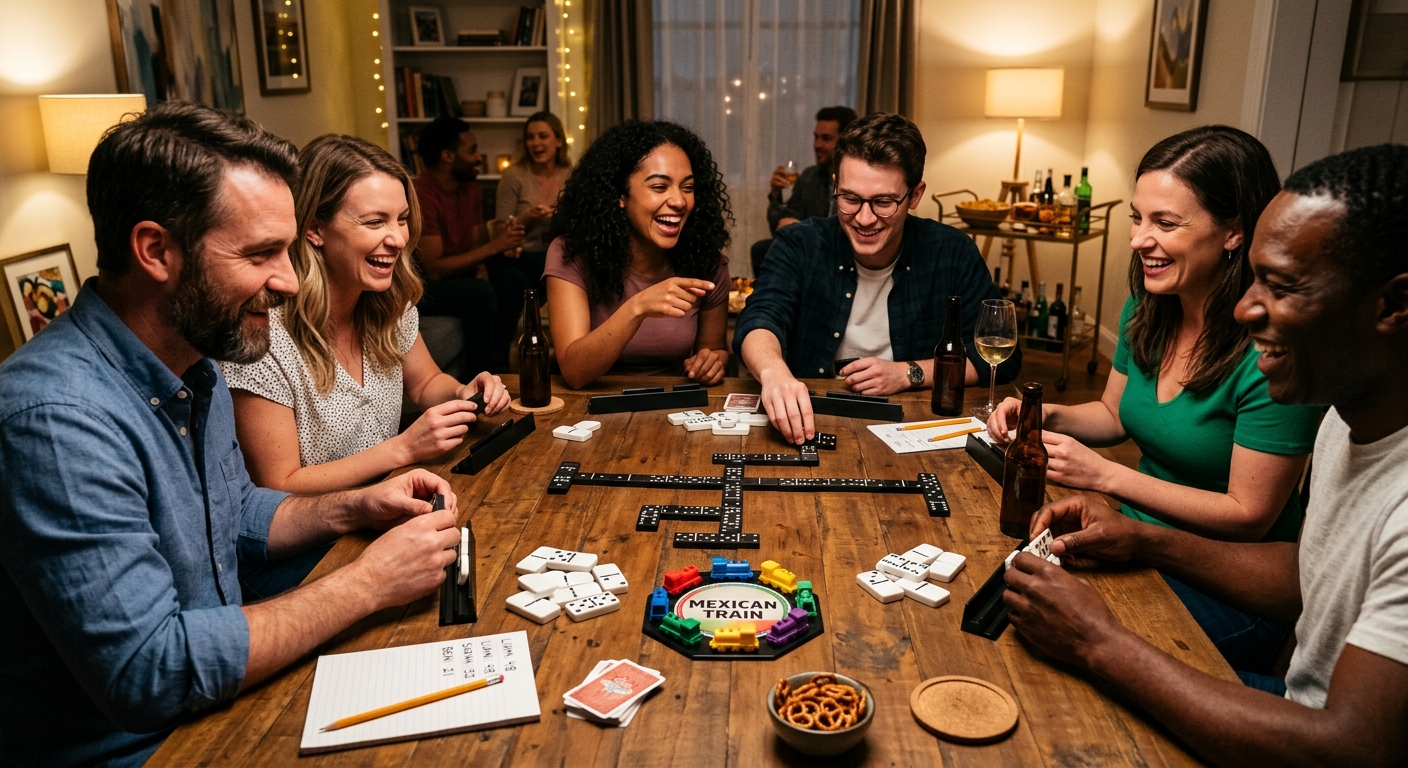
You flip the tiles face-down, give them a good shuffle, and watch everyone at the table lean in. That rattle of clicking pieces is a universal signal: the night has begun. Hosting a dominoes game night sounds simple on paper, but keeping a full table of mixed-skill players genuinely invested across two or three hours is its own craft. The difference between a night people talk about for weeks and one that quietly winds down by nine comes down to three things: choosing the right variant, teaching it without killing the mood, and knowing how to control the rhythm of the evening.
Host's Game Plan
- Match your variant to your group's size and experience before anyone sits down.
- Keep rule explanations under three minutes and let the first hand do the teaching.
- Use short transition activities between rounds to reset energy and keep everyone at the table.
Why the Variant You Choose Changes Everything
Not all dominoes games play the same way, and choosing the wrong one for your group is the fastest path to a disengaged table. The good news is that the three variants best suited to social hosting each serve a clearly different need, and picking the right one takes about thirty seconds once you know your crowd.
Block Dominoes is the entry point. The rules fit on a napkin. Each player draws their starting hand, matches ends along a chain, and the first to clear their tiles wins. There is no mid-game scoring to track, no judgment calls that slow things down, and no running total that leaves newcomers confused. For groups with first-timers or players who have not touched tiles since childhood, Block is where you start. It lets people get comfortable with the physical rhythm of the game before any strategy enters the picture.
All Fives, sometimes called Muggins, is the variant for people who want something to chase. Points are scored whenever the open ends of the layout add up to a multiple of five. That running score creates genuine competition in the middle of each hand, which keeps players leaning forward on every tile placement. Score-chasers will love the constant arithmetic and the way one clever move can shift the standings. It does require a bit more mental tracking, so save it for rounds after people have found their footing.
Bergen suits smaller groups, typically two or three players. Scoring happens when both open ends of the layout show the same number, which rewards patience and positional thinking over speed. At a four-person table it can feel slow, but at two players it is genuinely absorbing. The strategic depth in Bergen is real, and it tends to bring out the more reflective, deliberate side of competitive players.
Matching the Game to the People in the Room
Here is a breakdown to guide your decision before the first tile hits the table:
- Two or three players who enjoy tactical thinking: Bergen rewards careful positioning and gives smaller tables a satisfying competitive rhythm without the chaos of a full house.
- Four or more players with mixed experience levels: Start with Block to build confidence across the table, then transition to All Fives once everyone has settled in and the rules feel natural.
- A competitive group with at least some dominoes history: Go straight to All Fives and keep a running score across every round to sustain tension through the whole evening.
Getting this right before anyone sits down means you spend the night actually playing instead of untangling confusion at the table. A five-second decision before the night starts saves thirty minutes of friction during it.
Explaining Rules Without Losing the Room
The fastest way to deflate a game night is a ten-minute rules explanation before a single tile has been played. People do not absorb rules from a monologue. They absorb them by doing, and the sooner you get tiles in their hands, the better everything goes.
Pick one variant and explain it in under three minutes. Cover exactly three things: how to draw your starting hand, what a legal play looks like, and how the game ends. Leave scoring until the moment it first happens in real play. Explaining it in context, with an actual board state in front of everyone, lands better and sticks longer than any pre-game lecture ever will.
If you have one or two experienced players at the table, seat them beside the newer players rather than opposite them. Lateral coaching, a quiet word from the person sitting next to you, feels supportive rather than corrective. It keeps the game moving without making anyone feel singled out or embarrassed for not knowing the finer points.
The first hand will always be a little rough. That is fine. By the second hand, most players are working on instinct. By the third, they are thinking strategically. Trust the game to do the teaching once the tiles are in motion.
It is worth knowing that the double-six set most players reach for today has roots stretching back to 18th-century China, spreading to Europe through Italy before crossing the rest of the continent. Those centuries of transmission mean the game has been taught to new players in living rooms and pubs countless times over. One rough first hand is not a crisis. It is tradition.
Keeping a Mixed-Skill Table Invested All Night
A game with a skilled veteran and a first-time player can feel lopsided fast. The skilled player wins, the newer player shrugs, and the energy at the table drops. There are practical adjustments that prevent this from happening round after round.
- Rotate seating between rounds so experienced players are never consistently matched against the least experienced person at the table.
- Use a running score across rounds rather than declaring a winner after each individual game. One bad hand should not knock anyone out of contention for the whole evening.
- Introduce a fresh draw option for the trailing player: once per round, the player in last place may swap two of their tiles. It gives them a fighting chance without disrupting the flow for competitive players.
- Praise specific plays rather than just outcomes. Noting a smart tile choice by a newer player builds their confidence and keeps them emotionally in the game even when they are behind on points.
The goal is not to eliminate competition. The goal is to make sure every person at the table has something real to play for on every single round. When that is true, nobody checks their phone between hands.
Pacing the Evening and Keeping Energy High
A two-hour dominoes session is not just a series of games. It is an event with rhythm, and how you manage the transitions between rounds shapes how people feel through the whole night. Ignore the pacing and even a willing group will start to fade.
Between rounds, take five minutes. Stand up, refill drinks, have a conversation that has nothing to do with dominoes. A standing break does more for table energy than any in-game adjustment. Players come back to their seats ready to focus rather than grinding through mental fatigue.
Some hosts like to rotate in a fast, social filler game between tile rounds to shift the mood and get people laughing before they pick their tiles back up. If you want a short-round option that refreshes the table without pulling focus away from dominoes, a single round of play bunco works well as a palate cleanser between sets. For the overall night structure, three rounds of dominoes with two short breaks tends to be the sweet spot for most groups. Fewer than three rounds and people feel like the night ended before it started. More than four without a real rest and concentration slips noticeably at the table.
Knowing When to Switch Variants Mid-Evening
Read the table. If two rounds of Block Dominoes have people visibly relaxed and chatting between turns, introducing All Fives for round three will feel like a natural step up in stakes. If Bergen is dragging because the group turned out larger than expected, pivot to Block without making it a big announcement. You are the host. Flexibility is your most practical tool, and most players will not notice a smooth mid-evening shift.
Setting Up a Space That Actually Works
The physical setup of your game night matters more than most people expect. Tiles need room to spread out on the surface, and players need enough personal space to hold their hand without accidentally flashing tiles to the person beside them. A tile rack for each player is not essential, but it removes a persistent low-grade frustration for newer players who spend half their turn keeping tiles from tipping over.
Good lighting makes a real difference. Dominoes pips are small, and squinting at a dim table eats at everyone's patience over the course of an evening. If your usual game room is poorly lit, bring in a lamp. It is a small fix with a noticeable impact on how smoothly rounds move.
Keep the score on a shared board or a piece of paper that everyone at the table can see. Hidden scoreboards create doubt and quiet resentment. When the score is visible, it creates stakes. Players approach each hand differently when they can see exactly how far behind or ahead they are, and that visibility keeps the competitive tension alive between rounds.
The Signal That You Did Something Right
The hosts who run game nights that people actually want to repeat share one habit: they end on a high note. Do not wait until everyone is tired before calling the final round. End while people are still genuinely enjoying themselves and the energy at the table is still up.
Before people leave, announce the final score clearly, name the winner, and plant a seed for the next night. Something like, "Next time we should try All Fives with six people" gives everyone something to look forward to. They leave thinking about the next game rather than how long the last one ran.
A great dominoes night does not require special equipment, a big table, or a group of experienced players. It requires matching the game to the group, teaching without lecturing, protecting the pace, and making sure every person at the table feels like they were genuinely in contention the whole time. Get those four things right and the tiles will be back out before the month is over.