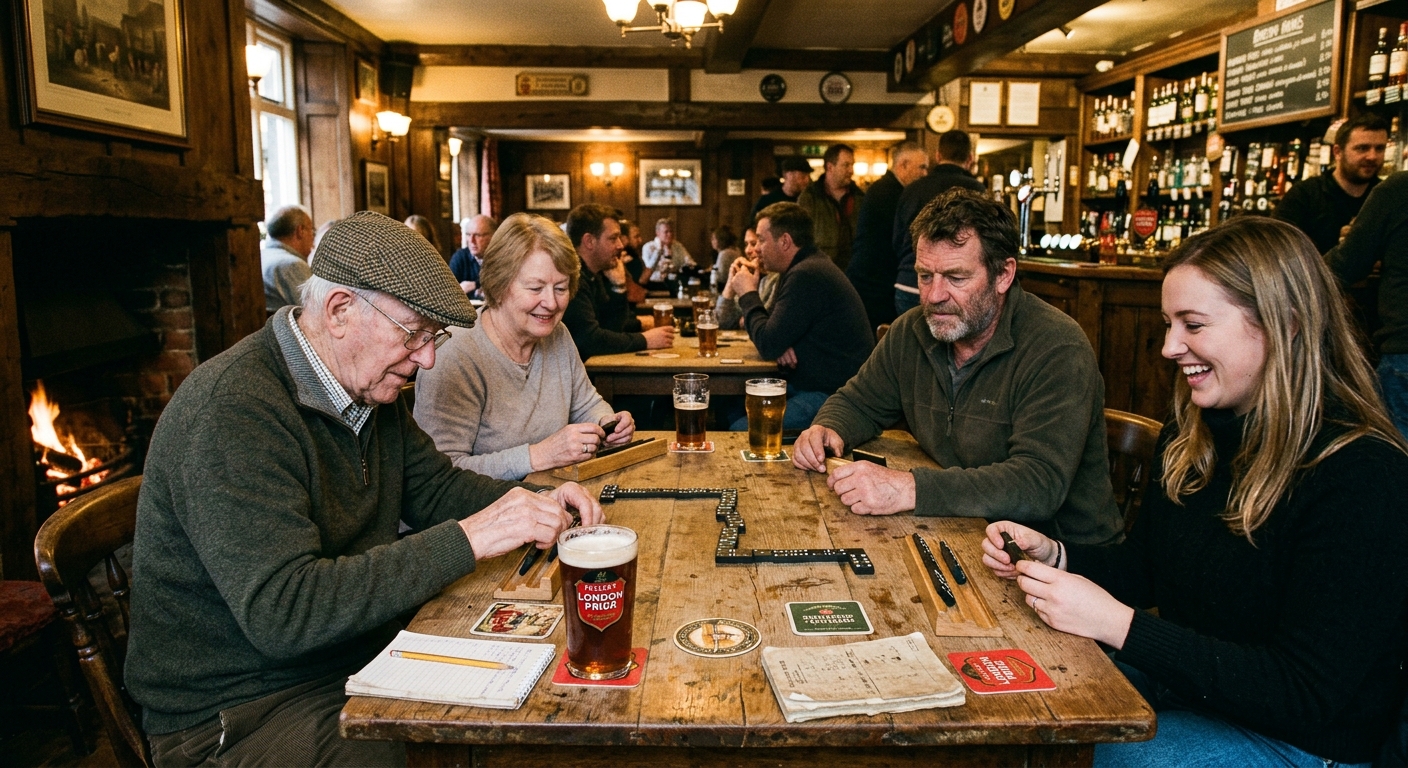
The sharp click of a domino landing on wood can cut straight through a busy pub. Someone studies the open ends. Someone else checks the score. Across the table, a partner tries very hard to keep a straight face. A small rectangle has just changed the mood of the evening.
That is the appeal of British pub dominoes. It gives people something to do together without demanding the whole room's attention. Beginners can join a friendly game. Experienced players can spend years improving. Between those two extremes sits a tradition built from familiar faces, local rivalries, and the promise of another hand.
British pub dominoes lasts because the game gives a social evening a shared purpose.
- League fixtures turn casual play into a recurring commitment between pubs and players.
- Table manners protect fair play while leaving room for conversation and friendly rivalry.
- Portable equipment and varied rules make dominoes easy to fit into different pub settings.
How a Travelling Game Found a British Home
Dominoes belongs to a much wider story than British beer gardens and back rooms. Earlier Chinese domino traditions and European tile games have their own histories. The precise route connecting them is less tidy than popular origin stories suggest.
European dominoes reached England by the late eighteenth century, arriving through France. An academic account of dominoes history places their English arrival in that period. British pubs inherited a travelling game and gave it a lasting local setting.
The fit makes sense. A domino set needs little storage. Players can arrange a game around an ordinary table. The pieces tolerate repeated handling, and the basic matching idea takes only a moment to explain. Those qualities suit a venue where people arrive at different times and may stay for one drink or an entire evening.
The pub also gives the game something a box of tiles cannot supply: continuity. A player returns and finds familiar opponents. A newcomer learns from someone who already knows the house rules. Small habits pass between generations through actual play.
This is cultural history at table level. It lives in how the tiles are mixed, how a score is checked, and who remembers the last close match. There need not be a famous inventor or a single founding pub for that history to matter.
The Local Rules That Give Each Table Its Character
There is no single game called British pub dominoes with identical rules everywhere. Block and Draw offer familiar matching play. Fives and Threes adds running arithmetic and has a strong association with British pub competition.
The established pub dominoes rules describe Fives and Threes as a British pub game played in leagues and tournaments. It uses a double-six set and can accommodate two to four players, with four commonly playing in partnerships.
For anyone arriving from another domino tradition, that variety matters. Knowing how tiles match does not mean knowing the scoring system. Before the first deal, settle the variant, the starting procedure, and what happens when nobody can play. Agree the winning target too.
Three Ways to Shape a Pub Game
| Variant | Main Feature | Appeal Around a Pub Table |
|---|---|---|
| Block | Players use their dealt tiles without drawing replacements. | Simple entry rules leave room for careful control of the open ends. |
| Draw | Players draw from available unused tiles under the agreed rules. | Fresh tiles can change a hand that appeared to be running out of options. |
| Fives and Threes | Open-end totals divisible by five or three earn points during play. | Frequent scoring decisions create tension throughout the hand. |
In Fives and Threes, an end total of nine earns three points. Ten earns two. Fifteen earns eight because it contains both five threes and three fives. Exposed doubles count both halves when calculating the ends. A cribbage board can keep the running score visible.
That arithmetic changes the feel of play. Getting rid of a tile is only part of the decision. You must also consider the score you take now and the opportunity you leave for the next player.
League Nights Turn Familiar Faces Into Teammates
A casual game fills an evening. A league gives people a reason to return next week.
Fixtures connect separate pubs through a shared competition. Players represent a venue, travel to opponents, and carry results back to their own regulars. The match can become a talking point long after the tiles have been packed away.
Partnership play adds another bond. Your decisions affect someone sitting across from you. A patient move may help that partner later. A careless scoring chance may put pressure on both of you. Learning to trust another player's judgment becomes part of learning the game.
League structures vary. Match formats, team sizes, scoring targets, and eligibility rules belong to the competition concerned. Anyone joining should read those rules rather than assume a friendly game's arrangements will carry across.
The social value is easier to recognise than any particular format. A fixture puts a date in the diary. It creates a role for someone who might otherwise visit only occasionally. Being expected at the table can make a pub feel more like a community.
None of this means every British pub still has a thriving domino team. Traditions depend on people organising them. A landlord who keeps the equipment available and a captain who brings players together can make an enormous difference.
The Unwritten Manners That Keep Competition Friendly
Pub etiquette begins before anyone plays a tile. Ask whether the table is available and whether the group welcomes another player. An empty chair may belong to someone returning from the bar. A league match may already have its players settled.
Once seated, keep drinks away from the layout and scoring equipment. Leave enough room for everyone to handle their tiles. These are modest courtesies, but cramped space and spilled beer can spoil a game faster than a bad hand.
Make your move clear. State a scoring claim plainly and allow it to be checked before the next turn. If there is a disagreement, count the ends again. A calm recount is more useful than an argument about who usually gets the arithmetic right.
In partnerships, let your legal play carry the information. Comments about missing numbers, meaningful gestures, or advice disguised as banter can undermine fair competition. Conversation belongs at the table. Secret coaching does not.
Spectators have responsibilities too. Watching a hand does not give you permission to suggest a move or reveal a tile. Save tactical discussion until the hand ends, unless the players have agreed that it is a teaching game.
The best hosts also make space for beginners. Explain a local rule before enforcing it. Give someone time to count. A tradition stays alive when its regulars help new people feel capable of joining.
The Strategy Behind an Apparently Simple Move
Dominoes rewards attention without requiring silence throughout the evening. That balance is central to its pub appeal.
A beginner sees matching numbers. A more experienced player notices which numbers have appeared and which numbers opponents cannot follow. Every visible tile narrows the unknown hand. Every pass offers information, though its meaning depends on the drawing rules.
Consider a Block game where an opponent passes with twos and sixes exposed. Under ordinary compulsory-play rules, that suggests they hold neither number. Keeping one of those ends available may restrict them again. Changing both ends may give them a route back into the hand.
Scoring games add another question. A move that earns points immediately may expose a useful total for your opponent. Sometimes the attractive score is still correct. Sometimes controlling the next turn is worth more.
There is no need to turn every friendly hand into a lecture. The pleasure comes from gradually seeing more. A tile that once looked obvious starts to carry several possibilities. Across repeated evenings, luck remains part of the game, but judgment becomes easier to recognise.
What Shares the Room on a Friday Night
Dominoes sits comfortably within a broader pub games culture. Depending on the venue, a Friday evening might include darts, pool, cribbage, a card game, or conversation around a board kept behind the bar. Older regional games may have their own corner too.
Each activity asks something different of the room. Darts needs a safe throwing area. Pool needs substantial floor space. Cards and dominoes can use ordinary seating, although both benefit from a stable surface and enough light.
For readers planning a full social evening beyond tiles, a drinking games list offers a companion resource for choosing another activity between domino sessions. Agree the format with the group and make participation comfortable for people choosing alcohol-free drinks.
A good evening needs rhythm. A concentrated partnership match can sit between more conversational activities. Friends who prefer watching can follow a close finish. Later, the same table can welcome a simpler game with a different mix of players.
Dominoes earns its place because it adapts to that rhythm. It can supply the evening's main contest or provide a shared activity while people catch up.
Why the Tiles Keep Coming Back
There is no reliable worldwide ranking that proves British pub dominoes has defeated every rival. Its claim to greatness rests on how much it offers with so little equipment.
A reusable set needs no power, subscription, or large playing area. Basic matching is approachable. Deeper play can remain demanding for decades. The same pieces serve several variants, allowing a group to change the level of challenge without buying another game.
The physical experience helps. Mixing the tiles marks a fresh start. Turning a hand face up makes the result shared and visible. Putting the set away signals that play is finished, even if the conversation continues.
Its endurance also comes from people having reasons to care. A stranger becomes a familiar opponent. A familiar opponent becomes a teammate. A narrow defeat becomes next week's rematch.
A Seat at the Table Is the Lasting Prize
British pubs made dominoes their own through repeated use. League nights gave it structure. Local rules gave it character. Table manners allowed serious competition and ordinary sociability to occupy the same small space.
To help that tradition continue, keep a set available, explain the rules clearly, and welcome the next player. The strongest move a regular can make may be offering someone a chair.
That is how a handful of tiles becomes one of the great bar games. It gives people a contest worth concentrating on and company worth returning for.